Publications
Peer-reviewed publications and scientific papers from Million Marker and our research partners.
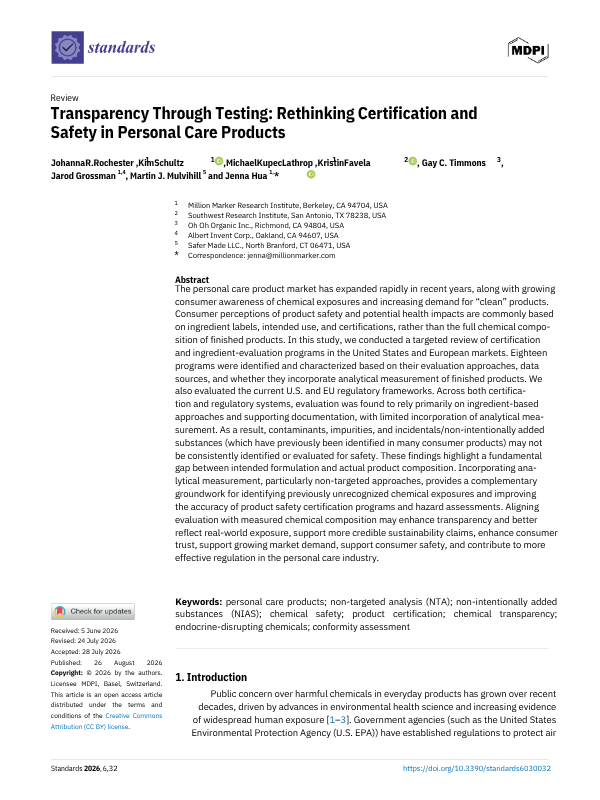
Transparency Through Testing: Rethinking Certification and Safety in Personal Care Products
The personal care product market has expanded rapidly in recent years, along with growing consumer awareness of chemical exposures and increasing demand for "clean" products. Consumer perceptions of product safety and potential health impacts are commonly based on ingredient labels, intended use, and certifications, rather than the full chemical composition of finished products. In this study, we conducted a targeted review of certification and ingredient-evaluation programs in the United States and European markets. Eighteen programs were identified and characterized based on their evaluation approaches, data sources, and whether they incorporate analytical measurement of finished products. We also evaluated the current U.S. and EU regulatory frameworks. Across both certification and regulatory systems, evaluation was found to rely primarily on ingredient-based approaches and supporting documentation, with limited incorporation of analytical measurement. As a result, contaminants, impurities, and incidentals/non-intentionally added substances (which have previously been identified in many consumer products) may not be consistently identified or evaluated for safety. These findings highlight a fundamental gap between intended formulation and actual product composition. Incorporating analytical measurement, particularly non-targeted approaches, provides a complementary groundwork for identifying previously unrecognized chemical exposures and improving the accuracy of product safety certification programs and hazard assessments. Aligning evaluation with measured chemical composition may enhance transparency and better reflect real-world exposure, support more credible sustainability claims, enhance consumer trust, support growing market demand, support consumer safety, and contribute to more effective regulation in the personal care industry.
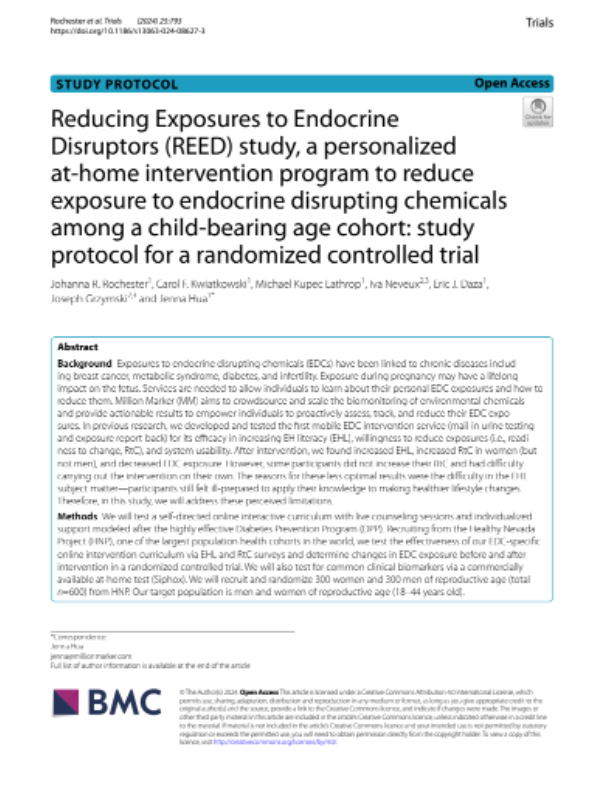
Reducing Exposures to Endocrine Disruptors (REED) study, a personalized at-home intervention program to reduce exposure to endocrine disrupting chemicals among a child-bearing age cohort: study protocol for a randomized controlled trial
This paper is about a study protocol that is currently being implemented by Million Marker. This study, which builds on our previous work, will demonstrate the efectiveness of the Million Marker endocrine disrupting chemical (EDC) exposure report-back on increased EDC environmental health literacy (EHL), readiness to reduce exposures (i.e. readiness to change, RtC), and exposure reduction itself, in EDC-tested individuals. Additionally, we hypothesize that providing further intervention beyond report-back (i.e. EDC-specifc EHL education and community support) will be a measurable improvement over report-back alone, in terms of EDC EHL and exposure reduction behavior, a reduction in individual exposures, and an improvement in clinical biomarkers.
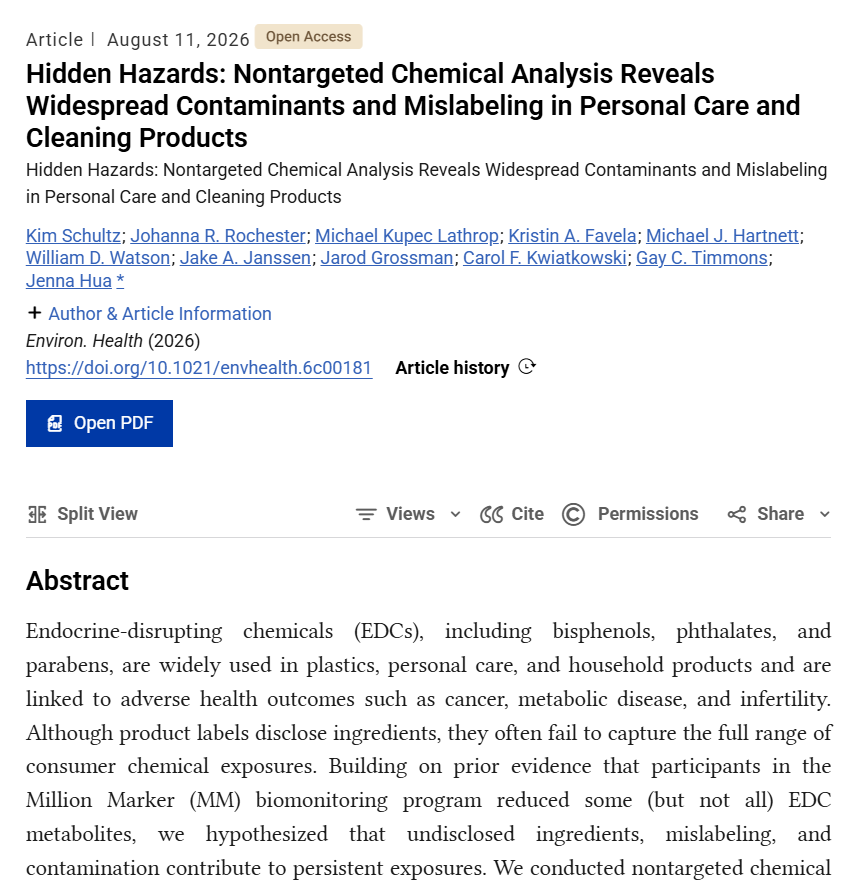
Hidden Hazards: Nontargeted Chemical Analysis Reveals Widespread Contaminants and Mislabeling in Personal Care and Cleaning Products
This study used advanced, nontargeted chemical testing on everyday personal care and cleaning products and found that most contained many more chemicals than listed on the label, including undisclosed and potentially harmful ingredients, even in products marketed as "natural," "non-toxic," or "fragrance-free."
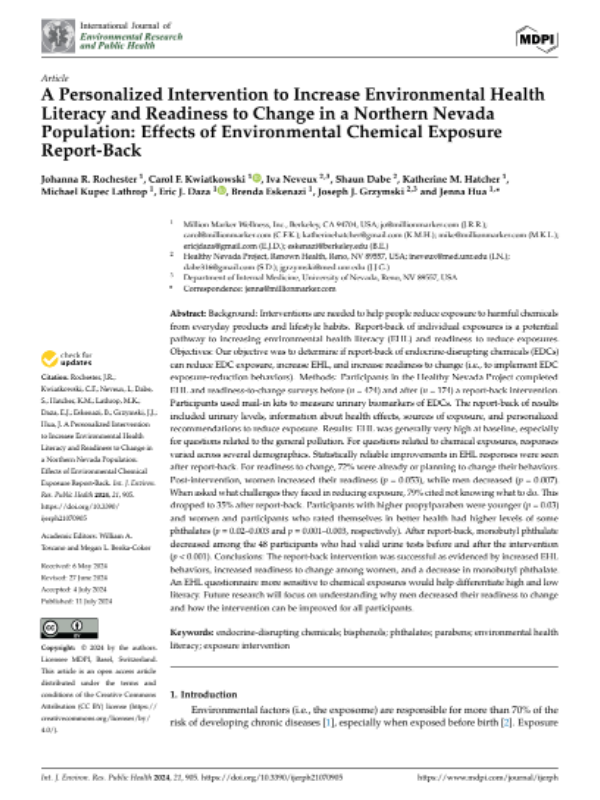
A Personalized Intervention to Increase Environmental Health Literacy and Readiness to Change in a Northern Nevada Population: Effects of Environmental Chemical Exposure Report-Back
Our objective was to determine if report-back of endocrine-disrupting chemicals (EDCs) can reduce EDC exposure, increase environmental health literacy (EHL), and increase readiness to change (i.e., to implement EDC exposure-reduction behaviors). Results showed that the report-back intervention was successful. The intervention increased EHL, increased readiness to change in women, and decreased exposure level to monobutyl phthalate (an EDC).
Associations Between Daily-Use Products and Urinary Biomarkers of Endocrine-Disrupting Chemicals in Adults of Reproductive Age
This pilot study explored the relationship between concentrations of EDCs in urine samples and products used 24 h prior to sample collection, and ingredients of concern in those products, in 140 adults of reproductive age in Northern Nevada. Results showed that higher levels of certain endocrine disruptors in urine samples and poor self-rated health were linked to the use of more products, especially personal care products and supplements.