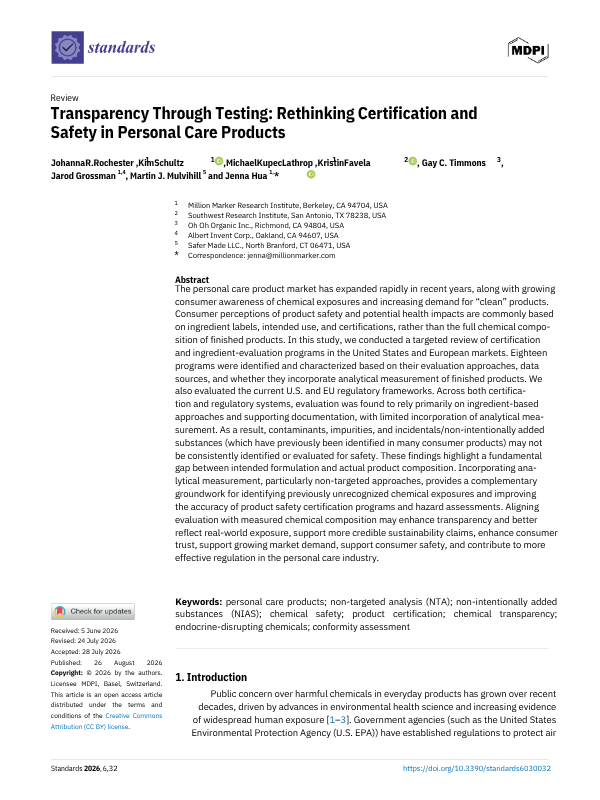
The personal care product market has expanded rapidly in recent years, along with growing consumer awareness of chemical exposures and increasing demand for "clean" products. Consumer perceptions of product safety and potential health impacts are commonly based on ingredient labels, intended use, and certifications, rather than the full chemical composition of finished products. In this study, we conducted a targeted review of certification and ingredient-evaluation programs in the United States and European markets. Eighteen programs were identified and characterized based on their evaluation approaches, data sources, and whether they incorporate analytical measurement of finished products. We also evaluated the current U.S. and EU regulatory frameworks. Across both certification and regulatory systems, evaluation was found to rely primarily on ingredient-based approaches and supporting documentation, with limited incorporation of analytical measurement. As a result, contaminants, impurities, and incidentals/non-intentionally added substances (which have previously been identified in many consumer products) may not be consistently identified or evaluated for safety. These findings highlight a fundamental gap between intended formulation and actual product composition. Incorporating analytical measurement, particularly non-targeted approaches, provides a complementary groundwork for identifying previously unrecognized chemical exposures and improving the accuracy of product safety certification programs and hazard assessments. Aligning evaluation with measured chemical composition may enhance transparency and better reflect real-world exposure, support more credible sustainability claims, enhance consumer trust, support growing market demand, support consumer safety, and contribute to more effective regulation in the personal care industry.